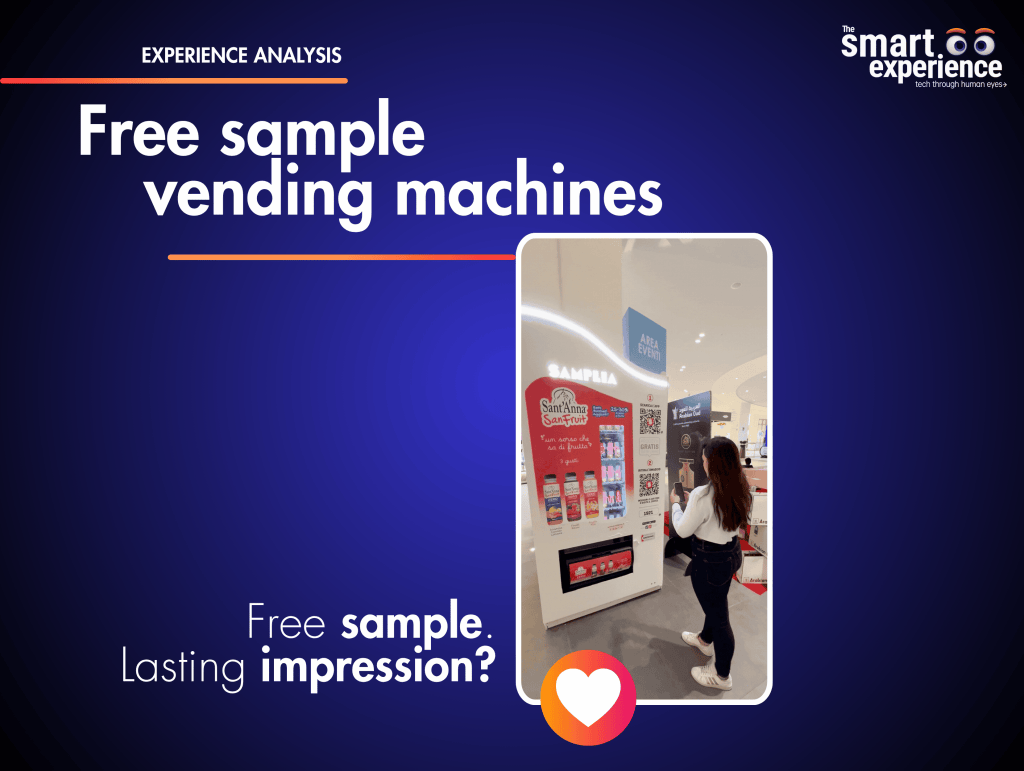
A free sample becomes an app journey. Explore the rewards, data exchanges, and technical failures that shape this vending machine experience.
A few years ago, visiting a supermarket or shopping for perfume and cosmetics often came with a small bonus: free samples. And who doesn’t like getting something for free? Today, that familiar sampling experience has found a different home: a vending machine connected to an app. The reward may be free. The experience still asks for my time and attention.
Even when the product wasn’t something we would normally buy, there was always a reason to give it a try. As we say in Colombia, “A caballo regalado no se le mira el colmillo” — something like to “You should accept a gift or a free item with gratitude instead of complaining or searching for its flaws”.
The mission is simple: find a machine, check the available products, and claim a free sample. Will there still be something left? That uncertainty has become part of the experience. When I manage to get a sample, it feels like a small achievement.
Experience Memory Outcome
A memorable idea whose reliability sometimes struggles to keep up with its appeal.

I would not describe the technology as invisible.
What stays with me is the small pleasure of discovering something, receiving it, and trying it later.
When everything works, the interaction is easy to follow. The machine provides the physical reward, while the app connects that moment to future opportunities.
Emotionally, the experience brings together curiosity, anticipation, and the satisfaction of completing a small mission.
Technologically, it depends on coordination between a device, a campaign, and a physical machine. Stock shortages and failed redemptions can quickly change how that coordination feels.
What is the Experience Memory Outcome?
It reflects the emotional aftertaste of an entire journey—not just what worked, but what stayed with you. It’s a framework I’ve been developing over the past few years, combining 8 human-tech interaction criteria to capture how usability, trust, and technology readiness and data transparency come together in one memorable (or not) experience. Outcome levels: 😍 Still Smiling, 😊 That Was Nice, 😌 Glad It Worked, 😕 Almost Worth It, 😩 Wish I Hadn’t
the Experience
A vending machine. A new interaction. After downloading an app, users identify the machine by scanning a QR code or entering its code. The user can then request an available sample.
Answering product surveys is also part of the mechanism that keeps access to future samples open.
The app becomes more than a digital ticket. It connects the first encounter, the product trial, and the next visit.
For brands, this creates a way to distribute products and collect feedback from people who have tried them. However, a large number of responses does not automatically make that feedback representative of the wider market. People willing to download an app for free samples are already a particular audience.
The experience connects a tangible reward with a continuing exchange of attention and feedback.
From the user’s perspective, the interaction looks simple: Scan → validate → receive the product.
Behind that interaction, several systems probably need to coordinate. Without knowing the provider’s implementation, the following is a technical hypothesis rather than a description of its actual architecture:
App → account verification → machine identification → campaign eligibility → stock check → redemption authorization → dispensing → confirmation → transaction record → survey → analytics.
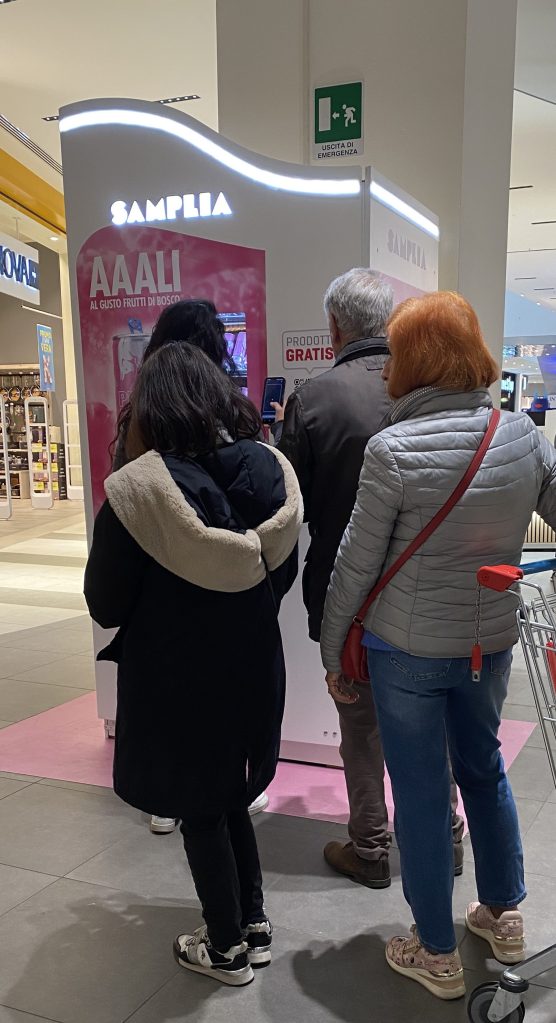
Each step answers a different question. Is this device eligible? Has this product already been collected? Is it still available? Did the machine actually dispense it? That last question matters most to the person standing in front of the machine.
The survey responses could also support a dataset of product preferences: which categories people try, what they enjoy, and what they say they might buy. This could inform segmentation or recommendations.

the YEAHs.
A small reward creates a reason to participate. There is a light game-like quality to finding the machine and completing the steps, although downloading an app and answering questions still require effort.
The app opens an ongoing conversation. One sample can introduce a brand; future campaigns give people a reason to return. The range can include drinks, chocolate, perfume, and everyday personal care products.
The physical network creates more opportunities for discovery. As locations expand, the service can reach different users. The audience still depends on where the machines are placed, samples availability and who chooses to participate.
Changing products keeps the experience interesting. There is a reason to check again because the next visit may offer something different.
Giving feedback adds a sense of involvement. When the user later sees a product the user sampled on a shop shelf, he remembers collecting it and sharing an opinion. The user feels connected to the journey.

the NOPEs.
The setup can interrupt the immediate reward. App download, machine identification, and survey requirements can feel substantial when someone expects a quick sample.
An empty machine can waste the visit. The disappointment is stronger when the app has not helped set expectations about availability.
A failed redemption can feel unfair. Experience a connection failure where the machine did not dispense the sample, but the app showed the ticket as used. From one’s perspective, request a reward present in the machine without receiving it.
how the Experience could Improve
💡 Design the conversation beyond the first sample. A product trial gives a brand a moment of attention. The next interaction should offer a reason to continue: useful product information, a relevant discovery, or a clear explanation of how feedback is used. Collecting contact details alone does not create that relationship.
💡 Give returning users meaningful progression. Some people will delete the app after their first sample. For those who stay, an optional discovery trail or a series of related products could make participation more interesting.
💡Keep feedback connected to the product trial. The survey makes sense because people have something concrete to evaluate. A short questionnaire, offered after enough time to try the product, could preserve that connection. It should distinguish between enjoying a free sample and being willing to buy the product at its actual price.
💡 Make failures understandable and recoverable. If the connection drops, the app should explain whether the request is pending, unsuccessful, or complete. Where technically feasible, an unsuccessful dispense should restore eligibility automatically. An unresolved case needs an accessible recovery route.
💡 Define completion around the physical outcome. An accepted authorization is only one step. For the person using the service, success means “the product is in my hand”. A possible transaction flow could distinguish authorized → dispensing → dispensed → completed, with separate paths for failures and uncertain outcomes. These are proposed states, not verified details of this provider’s system. Their usefulness would depend on what the machine can actually detect and confirm.
💡 Make preference-based personalization understandable. What is being combined? For what purpose? For how long? What can the person control? These questions belong in the design of the service, before introducing more personalization.
💡 Connect each visit to a worthwhile next discovery. Today, the mechanic feels largely transactional: action → reward. A possible evolution is discovery → action → reward → feedback → progression → new discovery. Its value would depend on whether each return feels worth the person’s time. The strongest reason to come back may be the expectation that the next experience will be interesting, clear, and reliable.
This article was written by a human and fine-tuned with generative AI. Thoughts are all mine; enjoy.


Leave a Reply