This article was written by a human and fine-tuned with generative AI. Thoughts are all mine; enjoy.
Although this post marks the anniversary of the concert I’m about to describe, the experience itself — still surprisingly underexplored in the entertainment industry — is now one of the most commonly used formats in live shows. And almost always, it feels the same.
A year ago, I attended one of the concerts that made me feel closest to home. The one that made me dance the most. The one that reminded me how deeply I admire the professional journey of an artist from my country, Colombia.
This time, the mission was easy: spend a joyful evening singing “Grito Herido” and sharing that moment with my Colombian friends abroad.
Experience Memory Outcome

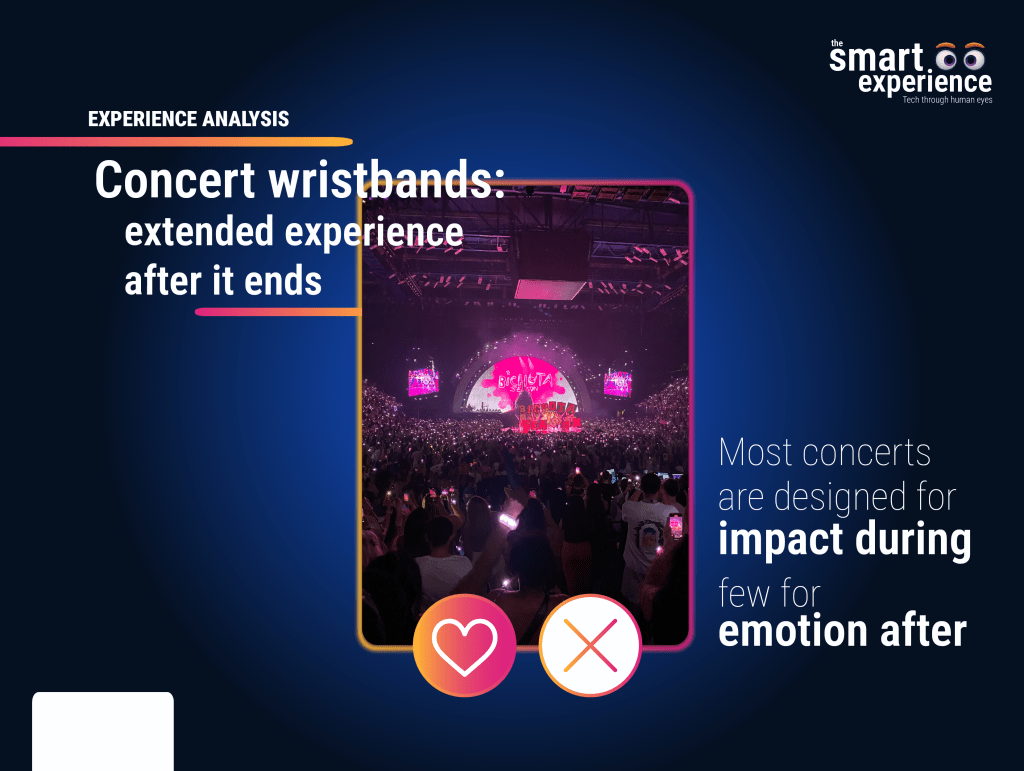
Most concerts design for:
Impact during. Few design for:
Emotion after.
Technology:
✔ Reduced distance
✔ Created collective choreography
✔ Extended temporal boundaries
✔ Required zero cognitive effort
✔ Symbolized identity
This is Memory Architecture, not Feature Architecture.
What is the Experience Memory Outcome?
It reflects the emotional aftertaste of an entire journey—not just what worked, but what stayed with you. It’s a framework I’ve been developing over the past few years, combining 8 human-tech interaction criteria to capture how usability, trust, and technology readiness and data transparency come together in one memorable (or not) experience. Outcome levels: 😍 Still Smiling, 😊 That Was Nice, 😌 Glad It Worked, 😕 Almost Worth It, 😩 Wish I Hadn’t
the Experience
After thinking we had lost our four tickets, my friends and I felt pure happiness when a new date opened — and we managed to get them. From that moment on, “fan mode” was fully activated. And yes, we were ready for everything (everything meaning hours in a virtual queue).
We waited for months in full concert mood. And finally, the day arrived.
At first glance, it looked like any other concert experience. We parked the car — paying five times the usual rate. We felt the contagious excitement of the most devoted fans. Security checks. Tables filled with confiscated prohibited items.
And right before entering, we received the now-famous light-up wristband. For two hours, I enjoyed the concert believing I would have to give it back. But it turned out to be the souvenir I carried home.
In this experience, the presence of a simple object — not highly advanced technology, but thoughtfully applied — shaped how I remember that night.
A year later, many details have faded. But the sum of those small details (including this wristband) built the emotional memory I now hold. A positive one. One I would gladly repeat.
The wristband turned off almost two days after the concert. And somehow, that was the exact moment I felt the experience truly ended.

the YEAHs.
The emotional element. Through a simple light wristband — multiplied by thousands of attendees — you feel connected not only to the artist but to everyone present. What happens there belongs only to those who are there. The lights move in sync with each song, perfectly coordinated.
The feeling of belonging. Anyone can wear a wristband. No training required. Just placing it visibly on your body becomes your contribution to the collective light show. It’s a subtle but powerful way to make attendees feel like participants — not just spectators.
Extending the experience. Because there was no way to turn it off, the wristband stayed on after the concert. It carried the good energy home. It extended the experience beyond the venue walls.
Breaking physical distance. Even for those seated far from the stage, the shared light choreography reduces the sense of separation. It creates collective presence.

the NOPEs.
No off switch. While the extended glow felt magical at first, the device stayed on for almost two days, constantly changing colors. I had to leave it outside my bedroom to sleep.
Sustainability concerns. For those of us who are environmentally conscious and don’t want to keep the device, disposal becomes an individual responsibility. That shouldn’t fall on the attendee. (Interestingly, bands like Coldplay already collect and reuse wristbands after their concerts.)
how the Experience could Improve
💡Taking a souvenir home can feel like a positive but incidental outcome. If we truly want to extend the experience, the wristband could have post-concert utility.
Imagine if it allowed you to “relive” key concert moments.
Imagine if it unlocked exclusive video or audio content.
Imagine if it became a key to a private digital space.
💡The wristband could serve as an access pass — extending the emotional journey a few hours, or even days, beyond the event.
💡For sustainability-conscious attendees, there could be clearly marked return stations where wristbands are collected and reused in future shows — making reuse part of the ritual itself.
💡Give attendees an active role during the concert. Through the wristband, they could respond to the artist’s questions. Vote for an acoustic song. Real time action! A small interaction can dramatically increase the sense of intimacy and closeness.
Ultimately, technology should not just amplify the show.
It should extend the memory. Because in the end, what we truly design is not the concert — but the emotional aftertaste people carry home.
 Juliana Onate-Berrocal
Leave a comment